🚩TryHackme Room Walkthrough: The Game
🎯 Objective
The Game is an easy reverse engineering room on TryHackme where the challenge revolves around extracting a hidden flag from a Windows game executable. Rather than requiring advanced reverse engineering techniques, the room teaches an important lesson: sensitive information stored inside client-side binaries can often be recovered with simple static analysis.
- Room URL:
https://tryhackme.com/room/hfb1thegame - Category: Reverse Engineering
- Difficulty: Easy
- Points: 30
- Tools:
strings,grep - Completed: May 2026
⚔️ Exploitation Steps
📥Step 1: Download and Inspect the File
- Download the task files from the room and unzip the archive. Inside you'll find
Tetrix.exe- a Windows game executable that supposedly contains our flag somewhere inside it.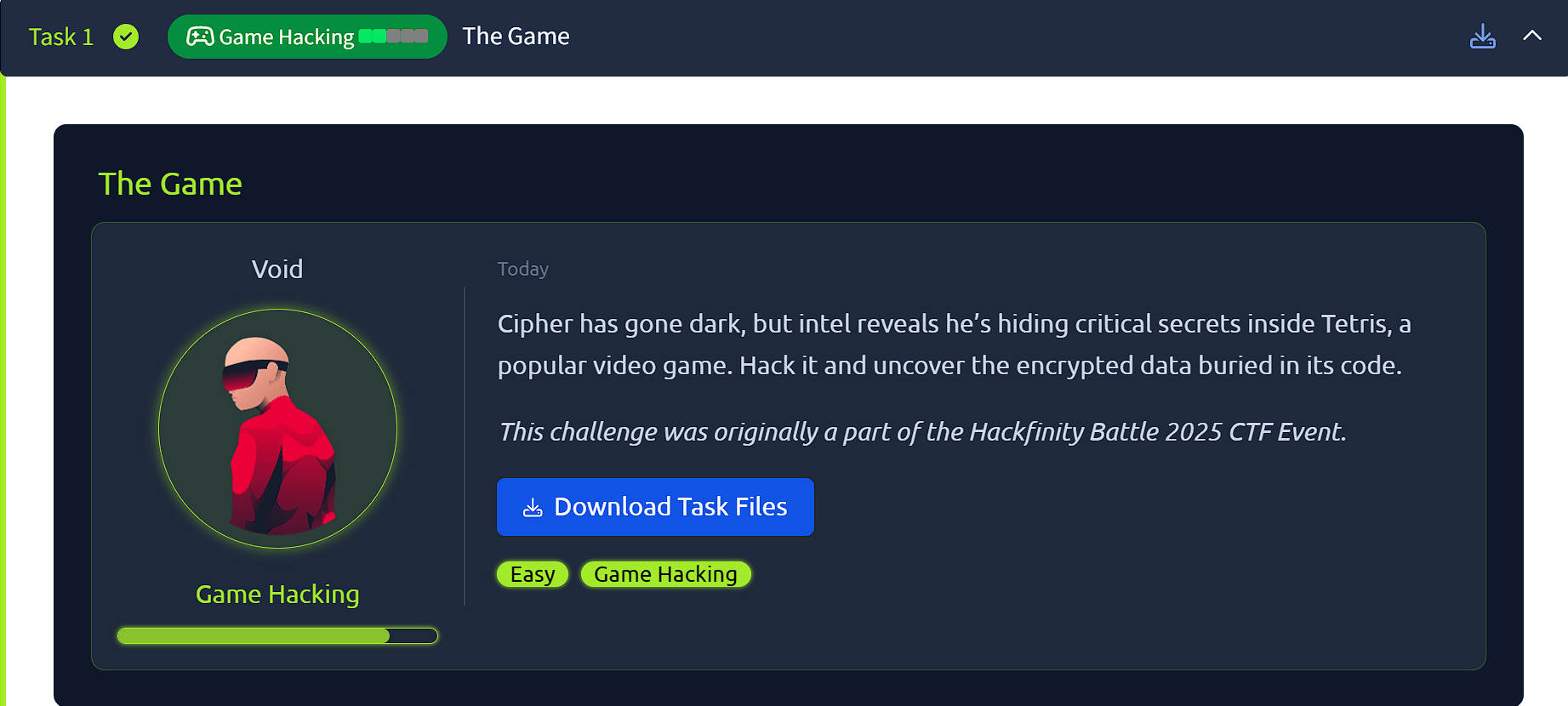

- Since exe is a binary file and binaries aren't pure machine code - they also contain data, error messages, UI text, hardcoded strings, encoded data, and sometimes things developers forgot to remove.
🔍Step 2: Extract the flag
- Since
Tetrix.exeis a binary file, we need to reverse engineer or decompile it to extract the flag buried inside our binary file. - However, There might be chances that our flag could be sitting in the binary as a plain readable text without any encryption.
- Therefore, Before decompiling the binary lets try printing all the strings present inside the file using
stringsand pipe it throughgrepto filter for the flag format.infostringsworks by scanning a binary file and printing any sequence of printable characters above a minimum length (4 by default). It doesn't care about the file format or language - it just reads what's there.grep THM{then filters the output down to only lines matching our flag format, cutting through all the noise.
- And💥Boom!, We got the flag sitting just as a plain readable text.
⚠️ Vulnerability
- The flag was stored as a hardcoded plaintext string inside the game executable. The developer likely assumed that distributing a compiled
.exewas enough to hide its contents - but compilation is not encryption. It just converts source code into machine instructions; it does nothing to protect static data embedded in the binary. - Any plaintext string in the source code - a password, a flag, an API key - will survive compilation and remain readable to anyone with
stringsor a hex editor. No reverse engineering skill required. This is a form of information disclosure: sensitive data exposed because it was stored somewhere it was assumed to be safe, but isn't.
🛡️ Mitigation
- The flag should never be in the binary in the first place.
- The right approach for something like this is server-side validation. The game sends a completion signal to a server, the server verifies it and responds with the flag. The client never holds the secret at any point, so there's nothing to extract.
- We could also go with encryption — store the flag encrypted and only decrypt it after server-side verification. But purely client-side decryption doesn't help here because the decryption key would also be in the binary, and we're back to the same problem.
- Obfuscation — splitting the string, encoding it, XORing it — would've made
strings | grepfail in this specific case. But it's not real protection. A debugger catches the value at runtime the moment it gets used. It raises the bar just enough to stop the laziest attempts, nothing more. - The only real fix is to keep the secrets off the client entirely.
📚 Lessons Learned
- Anything in a client-side binary should be treated as already public.
- And the habit to build from this room: whenever you're looking at a binary in a CTF, run
strings | grepfor the flag format before doing anything else. It won't always work, but when it does it just takes ten seconds. Start simple, escalate only when you need to.